Free: 30 calorie-cutting recipes + a 7-day plan → Get the guide




Mediterranean Diet 30-Day Challenge Review: Worth $37?

By Matthew & the Natural Healthier You team
Short version: The Mediterranean Diet 30-Day Challenge is a $37 digital bundle built around the most thoroughly studied eating pattern in the world — a 30-day structure, a 100+ recipe cookbook, daily meal calendars with matching shopping lists, plus five extras of varying usefulness.
The eating pattern itself is the real deal: it's the only dietary pattern with a large randomized trial behind it showing a hard health benefit, and it's the diet most people actually manage to keep.
The product is a reasonable way to start if you want structure.
It is not a weight-loss guarantee, and some of the bonuses are filler you can ignore if you choose.
That's the whole review in one paragraph.
The rest explains why — what's genuinely inside, which parts are worth your time, where the sales page oversells, and who should skip it entirely.
Disclosure: links to the Mediterranean Diet 30-Day Challenge in this article are affiliate links. If you buy through them we earn a commission at no extra cost to you. The "who should skip it" and "where it oversells" sections below are as honest as the rest — read them before you decide.
Why This Diet Is Different From the Ones You've Quit
Most diets fail for a structural reason: they end.
Keto ends when you eat a sandwich.
Whole30 ends on day 31.
A juice cleanse ends when you do.
Every one of them is built around a finish line, which means the moment you cross it, you're back where you started.
The Mediterranean pattern doesn't work that way, because there's nothing to finish.
It's not a protocol.
It's a description of how people in Crete, southern Italy, and coastal Greece have eaten for generations — olive oil as the main fat, vegetables and legumes most days, fish a couple of times a week, meat as a side dish rather than a centerpiece, meals eaten slowly with other people.
Nothing is banned.
That's not a marketing line — it's the actual structure.
There's no food that "breaks" it.
This matters more than it sounds like it should.
Research on what makes eating changes stick keeps pointing at the same thing: the plans people stay on are the ones that don't require them to leave their own life.
A pattern with no forbidden foods is easier to keep for five years than a pattern with a long list of rules you're white-knuckling through for five weeks.
So the question isn't "does the Mediterranean diet work?"
It's "is this particular $37 product a good way to start eating that way?"
Those are different questions, and the answer to the first one is much more flattering than the answer to the second.
What the 30-Day Challenge Actually Is
It's a digital bundle sold through ClickBank through a page at mediterraneanplan.com.
You pay $37 once, get instant access, and download a set of PDFs.
No subscription, no app, no physical product.
The sales page is presented as a letter from Kimberly Clark, "Nutritionist and Health Advisor."
I'll be straight with you: I could not independently verify that credential anywhere outside the product's own marketing.
That doesn't mean it's untrue — it means you should weigh it the way you'd weigh any unverified credential, which is not very much.
The eating pattern doesn't need her endorsement to be well-supported.
It was well-supported before she wrote a sales letter about it.
Here's the actual contents list, taken from the product's own sales page:
| Component | What it is | Honest assessment |
|---|---|---|
| Beginner’s Guide to the Mediterranean Diet | The “how this works” document — rules, principles, food guidance | Useful. This is the actual instruction manual. |
| The Incredible Mediterranean Diet Cookbook | ~92 pages, 100+ recipes including lower-calorie desserts | Useful. The core of the product. |
| The Official Mediterranean Diet Calendar | Daily meal plan with shopping lists built in | The most useful part. See below. |
| The Beach Body Program | Exercise and movement guidance | Situational. Fine, generic, not why you’d buy. |
| Detox guide | “Detoxification” guidance | Skip it. More on this below. |
| Winner’s Morning Routine Guide | Morning habits | Useful. Simple lifestyle change. |
| The Bulletproof Guide | Additional nutrition guidance | Useful. |
| Facebook accountability group | Community access | Depends on you. Works if you use it. |
What's Actually Inside (Week 1, From the Real Documents)
This is the part most reviews skip, and it's the part that tells you whether you'll use it.
I read the actual official meal plan PDF rather than the sales page.
Here's week one:
The shopping list is a real grocery list, not a prop. Week 1: cabbage, kale, salad greens, baby spinach, lemons and limes, fresh parsley and basil, bananas, three large red-skinned potatoes, two dozen eggs, fat-free sour cream, two pounds of chicken thighs, chicken breast, four pounds of lean grass-fed ground beef, plus pantry items. Ordinary supermarket food. Nothing you'd have to hunt for.
Day 1: Salmon omelet with a slice of whole-wheat bread, two ounces of mixed lettuce, and a teaspoon of balsamic. Lunch is spinach salad with avocado, macadamia nuts, and grilled chicken. Snack is strawberries and yogurt.
Day 2: Yogurt with fresh berries and a homemade nutty granola — sesame seeds, coconut flakes, rolled oats, cinnamon, olive oil, almonds, pumpkin seeds, cashews, vanilla. Lunch is a quick salmon chowder. Snack is a cashew dipping sauce with raw vegetables.
Day 3: Apple and cinnamon overnight oats. Chickpea and veggie medley for lunch, built from last night's leftovers. Ground beef taco salad for dinner.
Day 4: Green smoothie. Then leftover chicken thighs with a kale salad and quinoa — explicitly designed around what's already in your fridge. Chicken thigh taco bowl for dinner.
Day 5: Veggie omelet with whole-wheat toast.
Do you see the pattern? Day 3's lunch uses day 2's dinner. Day 4's lunch uses day 3's dinner. The plan is built around leftovers on purpose. That's a genuinely well-constructed meal plan and it's the sort of thing you only notice by reading the actual document instead of the sales page.
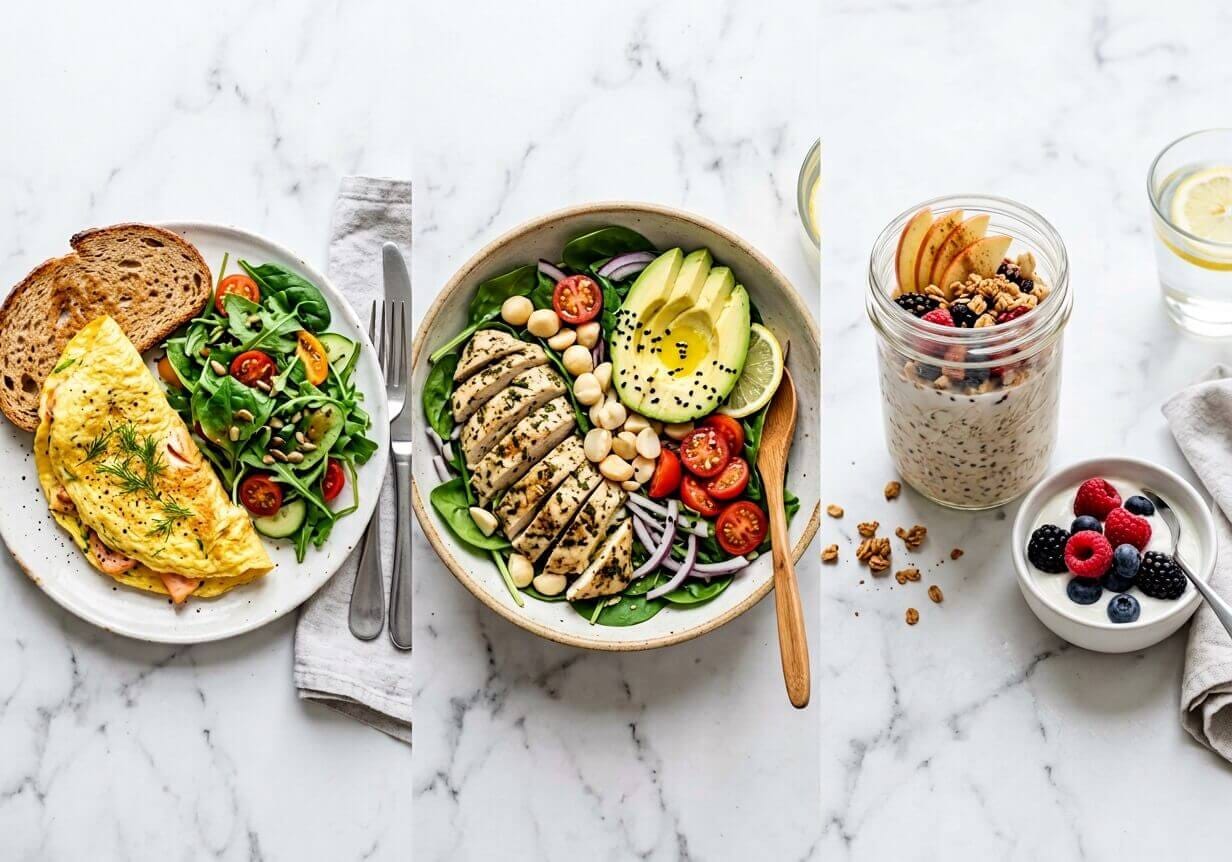
Three meals from week one: the salmon omelet, the spinach-avocado-chicken salad, and the apple-cinnamon overnight oats.
This is also where the product quietly answers the objection that kills most meal plans:
"I bought it, cooked two meals off it, and went back to takeout."
A plan that recycles its own leftovers is a plan that survives a Wednesday night.
The recipes are real food, written for someone who isn't a confident cook.
Omelets, salads, bowls, one-pan dinners.
Nothing requiring a technique you don't have.
Where the Sales Page Oversells
Now the part I'd want someone to tell me.
The "Italians eat pasta and stay thin" story is oversimplified.
The sales page leans hard on a comparison between an Italian family and an American family, and implies the difference is one secret food rule.
The real explanations are less satisfying: portion sizes, meal frequency, walking as transportation, food preparation, and a food culture that treats meals as social events rather than refueling stops.
Genetics do play a role too, whatever the page says.
The Mediterranean pattern is genuinely well-supported — you don't need the folk story to get there, and the folk story is doing the pattern a disservice.
"American food is POISON" is rhetoric, not a finding.
Processed food is engineered to be hyper-palatable and easy to overeat.
That's real and worth knowing.
But "poison" is a word chosen to make you angry, and anger is a bad reason to buy a meal plan.
The detox guide is the weakest item in the bundle, and you can skip it.
Your liver and kidneys already do this job, continuously, without assistance.
There is no convincing evidence that a dietary add-on meaningfully improves that process, and the NIH's own center for complementary health research has said as much about commercial detox products.
The detox PDF is a bonus designed to make the bundle feel bigger.
Ignore it and you lose nothing.
The countdown and "limited spots" language is theater.
The page says spots are restricted "to ensure personalized attention."
There is no personalized attention — it's a set of PDFs with instant automated delivery.
The price has been $37 for years.
None of this makes the product bad.
It makes the page unreliable, which is exactly why you're reading a review instead of buying straight off the sales letter.
The Science, Honestly
Here's where this product differs from most things I review: the underlying eating pattern has better evidence behind it than almost anything else in nutrition.
But the evidence says something slightly different from what the sales page implies, and the difference matters.
What's genuinely strong.
The PREDIMED trial is the largest randomized trial of a dietary pattern for heart health ever run — 7,447 people at high cardiovascular risk in Spain, followed for a median of 4.8 years.
It was not a weight-loss study.
Calories were unrestricted.
Participants were simply assigned to a Mediterranean diet with extra-virgin olive oil, a Mediterranean diet with nuts, or a low-fat control diet.
The olive oil group had 31% fewer major cardiovascular events than the control group.
The nuts group had 28% fewer.
(The trial was retracted and republished in 2018 after a randomization-documentation problem was found; the reanalyzed results were essentially unchanged, which is a point in its favor.)
Breaking out the individual outcomes, the reduction was driven mainly by stroke.
That's a real result from a real randomized trial.
Almost nothing else in the diet aisle can say that.
What's more modest than the page implies.
That "Italian" concept in your head — pasta, bread, wine, cheese, effortlessly slim.
Researchers thought so too, so they ran a second trial.
PREDIMED-Plus put 6,874 people on an energy-reduced Mediterranean diet with exercise and behavioral support.
After one year, the intervention group lost an average of 3.2 kg (about 7 lbs) versus 0.7 kg in the control group.
About 34% lost at least 5% of their body weight, versus 12% of the control group. That's a clinically meaningful result — and notice what it took: calories were restricted and exercise was added.
At three years, the intervention group had reduced total and visceral fat and preserved lean mass better than the control group.
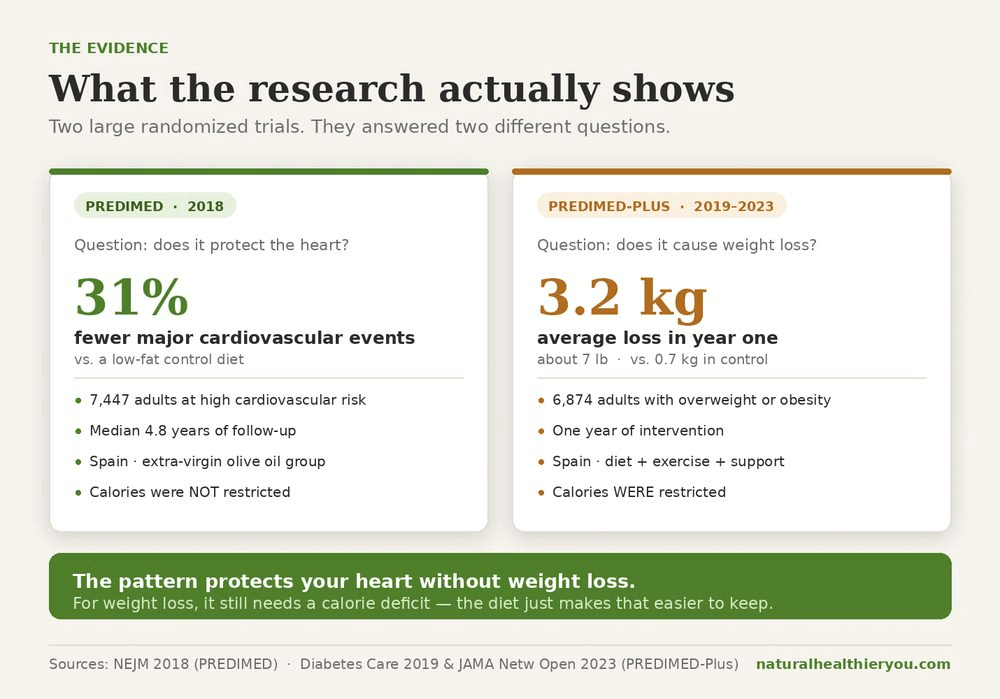
Two large randomized trials, two different questions. Only one of them tested weight loss.
So here's the honest summary the sales page won't give you:
The Mediterranean pattern is strongly supported for cardiovascular health, independent of weight loss.
For weight loss specifically, it works the same way everything works — you need a calorie deficit. What the pattern gives you is a way of eating that makes the deficit tolerable, because you're eating food you like and nothing is forbidden.
The diet is not a fat-burning mechanism. It's a structure that makes eating less easier to sustain.
That's a less exciting pitch. It's also true, and it's why the pattern has held up for decades while the exciting pitches cycle through every January.
One more point in its favor.
U.S. News & World Report's expert panel has ranked the Mediterranean diet the No. 1 overall diet for eight consecutive years through its 2025 rankings — and it also took first place in eight newer categories, including mental health, gut health, inflammation, high cholesterol, and fatty liver.
An expert panel ranking is not evidence.
But it's a useful signal about which pattern the people who study nutrition would pick for their own families.
Where This Fits With the No-Counting Approach
If you've read anything else on this site, you know we come back to a few ideas: protein first, vegetables for volume, portions by hand instead of by scale, and small swaps instead of big overhauls.
The Mediterranean pattern doesn't contradict any of that. It is that, with a thousand years of precedent.
The Mediterranean plate and the hand-portion plate are the same plate: a protein anchor, vegetables filling most of it, modest carbs, a thumb of fat (usually olive oil, in this case).
When you eat Mediterranean, the portions largely take care of themselves because the food is high-volume, high-fiber, and high-protein — the things that make you full.
There's one thing worth naming.
This plan does use calorie-controlled recipes, and PREDIMED-Plus worked because calories were reduced.
That's not the same as tracking every gram — nothing here asks you to log food or hit a macro target.
But if you've been assuming "no counting" means "no deficit," that's not it.
No counting is a method for getting into a deficit without hating your life.
That's the whole trick.
If you already have a handful of Mediterranean-ish meals you rotate, you don't need this product.
You need the free guide.
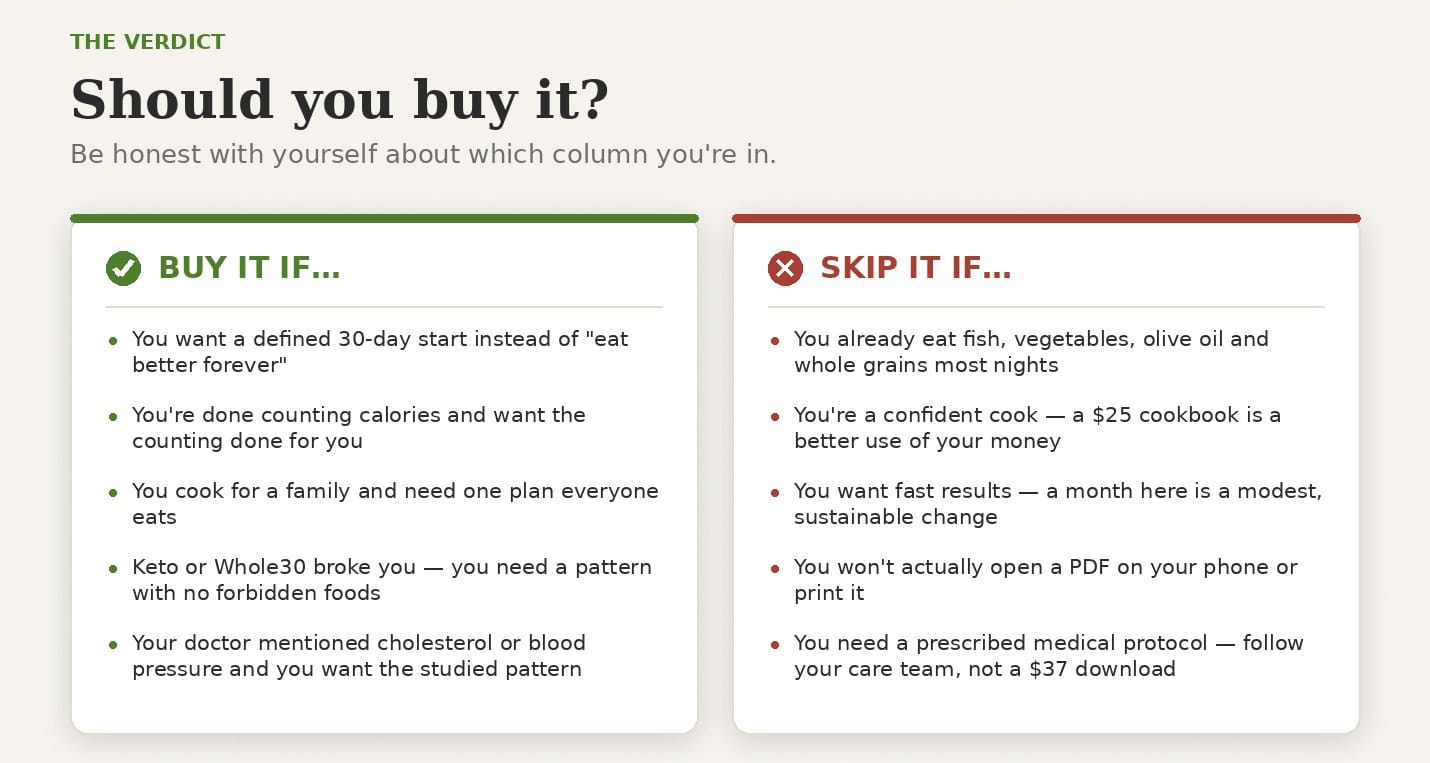
Who It's Good For
The person who needs a defined start.
"Follow this for 30 days" is psychologically easier than "eat better forever."
A start date and an end date make a change feel like something you're doing rather than something you're becoming.
The person who wants to stop counting.
If you've done the MyFitnessPal thing and hated every day of it, this is the most-studied alternative — a structure that produces a deficit without a spreadsheet.
The person cooking for a family.
One plan, one list, everybody eats the same dinner.
The recipes scale and nothing on the list is exotic enough to trigger a dinner-table revolt.
The person who's tried keto or Whole30 and couldn't stay on it.
Restriction is the thing that broke those.
This one has no restriction to break.
The heart-health-concerned.
If your doctor has mentioned cholesterol or blood pressure, this is the pattern with the trial behind it — not a supplement, not a powder.
Talk to your doctor about your specifics, but this is the direction they'd most likely point you.
The recipe-bored.
If you eat the same six meals until you can't stand them, 100+ recipes is a real fix for a real problem.
Who Should Skip It
You already eat this way.
If your dinners are fish, vegetables, olive oil, and whole grains most nights, you've already built what this sells.
Don't buy what you don't need.
You want the plan to do the work.
This is a set of PDFs. It will not cook, shop, or motivate.
If the problem is that you don't want to cook, this makes the cooking easier — it doesn't remove it.
You want fast.
Thirty days on this is a modest, sustainable change.
If you're looking for ten pounds by a wedding, the honest answer is that nothing legitimate delivers that, and anything claiming to is lying to you.
You need a specific medical protocol.
This isn't a therapeutic diet.
If you have kidney disease, a diagnosed GI condition, diabetes managed with medication, or any condition with a prescribed eating plan, follow your care team's instructions — not a $37 PDF.
You won't open a PDF.
Genuinely — if you know you won't read a document on your phone or print it, the cookbook and calendar will sit in your downloads folder.
Know yourself.
Buy a cookbook you'll actually open instead.
You're put off by hype.
The sales page is loud.
If "American food is POISON" and a pants-splitting story make you want to close the tab, close the tab.
The information is available free from the sources at the bottom of this article.
Honest Pros and Cons
Pros
The underlying eating pattern has the strongest evidence base in nutrition — a large randomized trial with hard endpoints, not just observational data
No forbidden foods, so there's nothing to "cheat" on and no cycle to fall off
Real, specific bonus: the meal calendar with built-in shopping lists and deliberate leftover reuse
Ordinary supermarket ingredients — the week 1 list is $15-a-person-per-day real, not specialty-store aspirational
100+ recipes is enough variety to actually run 30 days without repetition
$37 once, no subscription, 60-day money-back guarantee through ClickBank
Reverses cleanly if you don't like it — ClickBank honors refunds reliably
Cons
Three of the eight bonuses are padding; the "over $200 value" claim is invented
The detox guide isn't just useless, it's the kind of thing that makes you distrust the rest of the bundle
No app, no tracking, no automation. It's a document, and 1990s-style delivery
The Facebook group is only as good as the group, and you're dependent on strangers
The sales page's central argument — that Italians are thin because of one secret — is a story, not a finding
Advanced cooks will outgrow it; the recipes are deliberately simple
You still have to cook. Every day. That's the actual work, and no product removes it
What $37 Actually Buys You
"Is it worth it" is really "compared to what?" Let's answer that honestly.
| Option | Typical cost | What you get |
|---|---|---|
| The Mediterranean Diet 30-Day Challenge | $37 once | 8 digital items; ~4 genuinely useful; 30-day structure with lists |
| A good Mediterranean cookbook | $20–35 | Better recipe quality, no plan, no shopping lists |
| A dietitian visit | $75–200/session | Actual personalization for your body and conditions |
| Meal-kit delivery | $60–120/week | Food arrives; costs 10x more over a month; ends when you stop paying |
| Meal-planning app | $5–15/month | Software; ongoing cost; you still decide what to cook |
| Free 7-day guide on this site | $0 | 30 recipes, a week of structure, a shopping list, a swap sheet |
Here's the honest comparison most reviews won't make: our free guide gets you a week. This gets you a month, with more recipes and a calendar.
If a week is enough to tell you whether you like eating this way, take the free guide and save your $37.
If you already know you like it and just want the next 30 days handled, $37 for a month of decisions made in advance is a reasonable trade — it's less than two takeout dinners.
The cookbook comparison is the one that should give you pause.
If you're a confident cook, a $25 Mediterranean cookbook from a well-regarded author is a better use of money than this bundle.
The bundle's value isn't the recipes — it's that the decisions are already made and the shopping list is already written.
That's what you're paying for. Buy it for that reason or don't buy it.
What You'll See at Checkout (So Nothing Surprises You)
The $37 is the front end. Like most ClickBank products, there's an upsell sequence after you click buy. Here's what to expect, so the order page doesn't catch you off guard:
The order form itself may offer an additional item as a checkbox. Uncheck anything you don't want — it's optional and it's designed to be easy to miss.
Upsells after purchase. You'll be shown one or more additional offers, usually with a countdown timer. The timer is a device. Decline anything you're unsure about; there is no penalty for saying no to all of them, and the front-end product works fine without them.
Your confirmation email. Save it. It contains your download access and your ClickBank receipt, which is what you'll need if you request the refund.
Our honest advice: buy the $37 bundle and decline everything else.
The bonuses in the core bundle already include more than you'll use in 30 days.
If you finish the month and want more, come back and buy more.
Don't buy the month-two solution on day one — you don't know yet whether you'll want it.
The 60-day refund window is generous and ClickBank honors it.
If you buy it, read the beginner's guide, and realize it isn't for you, ask for your money back.
Five Mistakes People Make With Any 30-Day Plan
These apply to this product and every other plan you'll ever buy.
1. Trying to follow it perfectly. Missed day 4? Start at day 5. The plan is a default, not a contract. The people who quit are the ones who treated one missed meal as a verdict.
2. Skipping the shopping list. The list is where the decision-removal actually happens. Screenshot it, take it into the store, buy what's on it. If you improvise the shopping, you've bought an expensive PDF.
3. Ignoring portions. A meal plan tells you what. It can't see your plate. Apply the hand method at serving time — palm of protein, fist of vegetables, cupped hand of carbs, thumb of fat (that's your olive oil).
4. Drinking your calories back. Olive oil, nuts, and cheese are all on this plan and all are calorie-dense. A "drizzle" that turns into four tablespoons is 480 calories. Measure the oil for the first two weeks until your eye recalibrates.
5. Treating day 31 as graduation. Thirty days builds a habit; it doesn't finish a change. The reason to pick this pattern is that you don't stop. Keep four or five dinners you liked and rotate them forever. That's the whole plan, permanently.
Frequently Asked Questions
Is the Mediterranean diet actually a diet?
Not in the way you're probably using the word.
There are no forbidden foods and no calorie target to hit on the traditional version.
It's a description of a pattern: olive oil as the primary fat, vegetables and legumes daily, fish a few times a week, meat occasionally, meals eaten slowly.
That's why people stay on it — there's nothing to fall off of.
Will I actually lose weight on it?
If you eat less than you burn, yes — and the pattern makes that easier because the food is filling.
PREDIMED-Plus showed about 7 pounds lost in the first year on an energy-reduced Mediterranean diet with exercise, with about a third of participants losing 5% or more of their body weight.
Without a calorie reduction, expect the health benefits without much weight change.
This plan's recipes are calorie-controlled, which is how it aims at a deficit.
How fast does it work?
For weight, a sustainable pace is 0.5–1 pound a week, occasionally more in the first week from water.
For heart-health markers, the trial that showed benefit ran for a median of 4.8 years.
Anyone promising you a timeline faster than that is selling something other than health.
Do I have to count calories or macros?
No.
This plan gives you calorie-controlled recipes and a set structure, so the counting is done for you in advance.
Pair it with hand portions at serving time and you never open a tracking app.
Can I do this if I'm vegetarian, gluten-free, or dairy-free?
Mostly, with substitution.
Legumes, vegetables, whole grains, nuts, and olive oil are the backbone of the plan and are all vegetarian-friendly.
Fish features heavily, though, so vegetarians will be swapping protein sources regularly — get protein from legumes, eggs, dairy, and tofu instead.
Gluten appears in the breads, pasta, and oats; dairy appears in the yogurt, cheese, and sour cream.
This isn't a purpose-built plan for either restriction.
What if I don't like fish?
You'll be working around a fair number of meals.
Poultry, eggs, legumes, and Greek yogurt cover most of the same nutritional ground, and the plan is a template rather than a locked menu.
But if fish is a hard no, be aware you'll be doing more substitution than the average buyer.
Is $37 a one-time payment?
Yes. No subscription, no recurring billing. 60-day money-back guarantee through ClickBank.
Is the Facebook group worth it?
It's included, so the only cost is your attention.
Structured group support does help people stick with changes.
Whether this particular group is active and useful is not something I can evaluate from outside, and it may change over time.
Treat it as a bonus you might use rather than a reason to buy.
How is this different from The Simple Slim Kitchen?
The Simple Slim Kitchen is $17, gives you 62 recipes and a 30-day structure, and is built around ordinary protein-and-vegetable meals with no particular cuisine.
The Mediterranean Challenge is $37, gives you 100+ recipes plus daily calendars and lists, and is built around one specific, heavily studied eating pattern.
If you want the cheapest route to "dinner is decided," take the Simple Slim Kitchen.
If you specifically want to eat the Mediterranean way, take this one.
Both work.
They're different shapes of the same idea.
What happens after the 30 days?
You keep the documents forever and repeat or adapt what worked.
There's no day-31 upsell required to keep eating this way — the food is at your grocery store.
If our free 7-day guide is what brought you here, note that it's built to dovetail with this: use the free week to test the pattern, then use this if you want the following month structured too.
The Bottom Line
The Mediterranean diet has the best evidence of any eating pattern and the fewest reasons to quit.
That's not marketing — it's the reason a randomized trial could show a heart benefit at all.
This product is a decent, honestly-priced way to start eating that way.
Its best asset is the 30-day calendar with built-in shopping lists and deliberate leftover reuse.
Its worst assets are a detox guide you should ignore and a sales page that argues its case with a story instead of the evidence it actually has.
If you want a month of eating decisions made in advance and you're not already confident in the kitchen, $37 is a fair price — with a 60-day guarantee if it isn't for you.
If you're already eating this way, or you're a confident cook, or you're not sure yet whether you even like the food — skip it.
Start with the free guide, eat the week, and decide afterward.
That's not a sales pitch, it's just the correct order of operations.
FREE DOWNLOAD
Want These Meals Already Built Into a Week of Meals?
Our free Simple 7-Day Healthy Weight-Loss Guide includes 30 easy recipes under 450 calories, a one-page shopping list, ten swaps that save 100+ calories, and a day-by-day plan — built around the same principles the Mediterranean pattern uses. Start there, then decide whether you want the next 30 days structured too.
No spam. Unsubscribe anytime.
Sources
Estruch R, Ros E, Salas-Salvadó J, et al. "Primary Prevention of Cardiovascular Disease with a Mediterranean Diet Supplemented with Extra-Virgin Olive Oil or Nuts." New England Journal of Medicine, 2018;378(25):e34. (PREDIMED, republished and reanalyzed.) https://www.nejm.org/doi/full/10.1056/NEJMoa1800389
Harvard T.H. Chan School of Public Health, The Nutrition Source. "PREDIMED Study Retraction and Republication: What Changed, What Didn't, and the Big Picture." 2018. https://nutritionsource.hsph.harvard.edu/2018/06/22/predimed-retraction-republication/
Salas-Salvadó J, Díaz-López A, Ruiz-Canela M, et al. "Effect of a Lifestyle Intervention Program With Energy-Restricted Mediterranean Diet and Exercise on Weight Loss and Cardiovascular Risk Factors: One-Year Results of the PREDIMED-Plus Trial." Diabetes Care, 2019;42(5):777–788.
Konieczna J, Ruiz-Canela M, Galmes-Panades AM, et al. "An Energy-Reduced Mediterranean Diet, Physical Activity, and Body Composition: An Interim Subgroup Analysis of the PREDIMED-Plus Randomized Clinical Trial." JAMA Network Open, 2023;6(10):e2337994.
U.S. News & World Report. "Best Diets 2025." Expert panel rankings, 15th edition, January 2025.
National Center for Complementary and Integrative Health, National Institutes of Health. "Detoxes and Cleanses: What You Need To Know." https://www.nccih.nih.gov/health/detoxes-and-cleanses-what-you-need-to-know
Mazza E, Ferro Y, Pujia R, et al. "Mediterranean Diet In Healthy Lifestyle And Prevention Of Cardiovascular Disease." Current Opinion in Lipidology / reviewed in Cardiovascular Research, 2025;121(16):2465.
Product contents, pricing, guarantee terms and sample meal plan verified against mediterraneanplan.com and its official downloadable meal plan PDF, September 2026.
⚕️ Medical Disclaimer
This article is for general informational purposes only and is not medical advice.
The Mediterranean Diet 30-Day Challenge is an educational product, not a treatment, and nothing here should be read as a claim that it diagnoses, treats, cures, or prevents any disease.
The PREDIMED trial studied a specific population — older adults in Spain at elevated cardiovascular risk — and its results do not necessarily generalize to everyone. Individual results vary.
Talk to your healthcare provider before changing your diet, especially if you are pregnant or breastfeeding, have diabetes, kidney disease, liver disease, a gastrointestinal condition, a history of disordered eating, or take prescription medication. Do not stop or change any medication based on anything you read here.
This article contains affiliate links. See our full affiliate disclosure and medical disclaimer.
About this article
Written by Matthew and the Natural Healthier You team
We write about the small, boring habits that actually stick: protein first, half-plate vegetables, fewer calories you drink. Every claim links to a peer-reviewed study or a public health source in the Sources list. We test recipes in our own kitchens, and when we recommend a product we say who it is not for. Nothing here is medical advice.
How we research and choose what to recommend →Free 7-day guide →
NATURAL HEALTHIER YOU
Simple, practical health and weight-loss guidance for real life.
Natural Healthier You. All rights reserved. Content is for general informational purposes only and is not medical advice. Consult your healthcare provider before starting any diet or supplement. Some links on this site are affiliate links; we may earn a commission at no extra cost to you.