Free: 30 calorie-cutting recipes + a 7-day plan → Get the guide




The Hand Portion Method: Control Portions Without Counting a Single Calorie

By Matthew & the Natural Healthier You team
In 1992, researchers at Columbia University studied a group of people who insisted they couldn't lose weight. They said they were eating about 1,000 calories a day and the scale wouldn't budge.
They were sure something was wrong with their metabolism.
So the researchers measured their actual intake with the most accurate tool in nutrition science — a method called doubly labeled water, which tracks energy use at the molecular level.
The group wasn't eating 1,028 calories a day. They were eating 2,081 [1].
They weren't lying. Their portion estimates in a lab test were accurate.
What failed was memory — when asked to recall a controlled meal 24 hours later, they remembered about 20% less food than they'd eaten.
Snacks vanished.
Cooking oil didn't count.
The handful of crackers while making dinner never happened.
Here's why that study matters to you: it's why calorie counting fails for most people.
Not because the math is wrong, but because the input is.
You can't count what you don't remember eating, and you can't measure what you didn't weigh.
Follow-up research over three decades found the same thing — people underreport what they eat by 20–50%, and the busier and more tired you are, the worse it gets [2].
What you need isn't a more accurate app.
It's a measuring tool that's always with you, scales automatically to your body, and requires zero recall.
You're looking at it. It's your hand.
Why Portions Went Wrong in the First Place
Before the method, it helps to understand the problem it solves, because most people don't have an eating problem.
They have a calibration problem.
Consider what's happened to "normal" over the last fifty years. A bagel in the 1970s was 3 inches across and about 140 calories.
Today's is 6 inches and 350.
A muffin has gone from 1.5 oz to 4 oz.
A restaurant pasta portion is now routinely 3–4 cups — enough for three servings.
Sodas went from 6.5 oz bottles to 20 oz standards.
Researchers call this portion distortion: when everything around you is oversized, oversized starts to look normal [3].
And your brain uses what looks normal, not what your body needs, to decide when to stop.
Cornell's food lab demonstrated this over and over:
Diners given a large serving bowl served themselves 77% more pasta than diners given a medium one — and reported no difference in how good it tasted [4].
Even nutrition experts given a larger bowl and a larger spoon served themselves 31% more ice cream, then estimated they'd taken the same amount as the small-bowl group [5].
People eating from a secretly self-refilling soup bowl ate 73% more than the control group, but rated themselves no fuller and estimated they'd eaten the same amount [6].
Read that last one again.
They ate 73% more and didn't know.
This is the trap.
You're not overeating because you lack discipline.
You're overeating because every visual cue in your environment — the plate, the bowl, the package, the restaurant — is telling you a distorted portion is the right one, and your fullness signal is too slow to overrule it.
The fix is a reference point that doesn't change no matter what plate you're handed.
That's the hand.
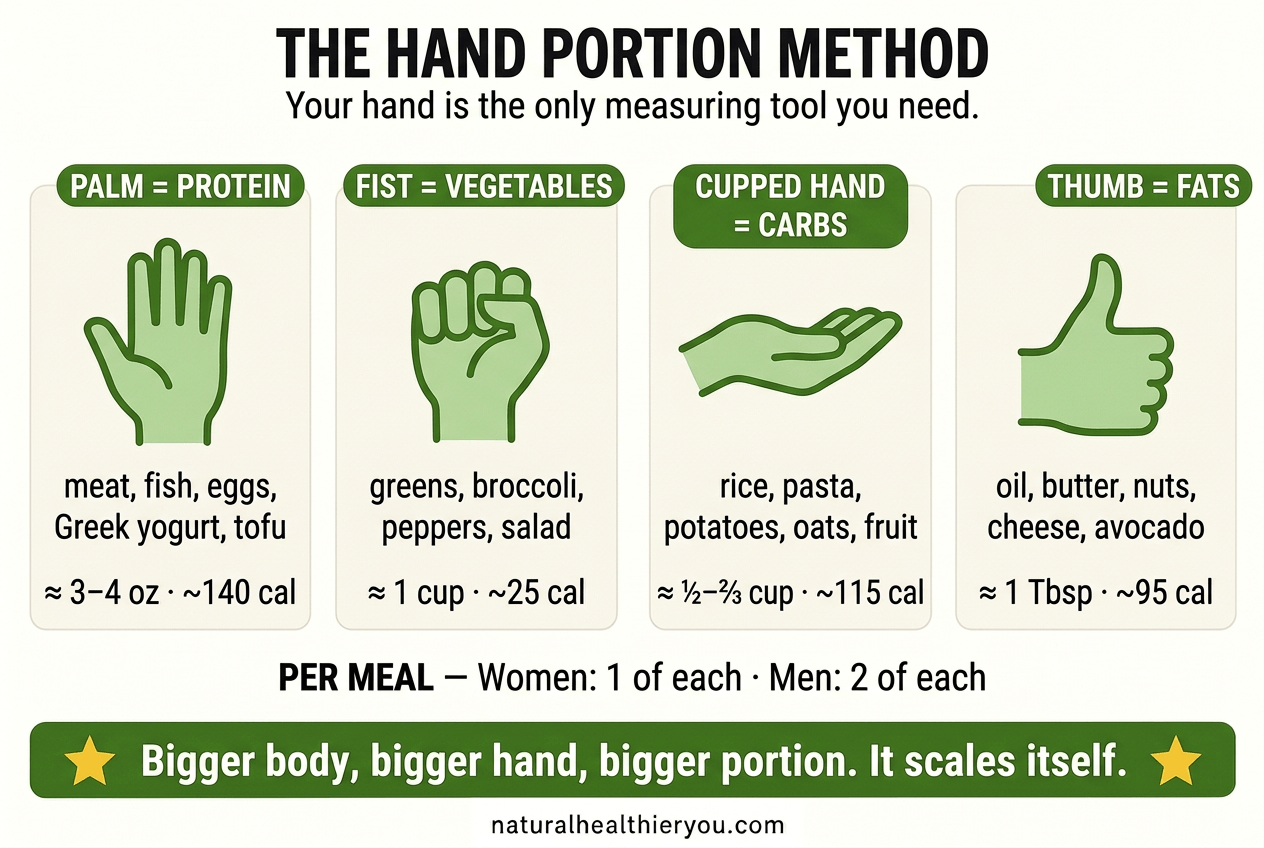
The Hand Portion Method: Four Measures, That's It
The method was popularized by the coaching company Precision Nutrition, who've used it with over 100,000 clients, and it's built on a simple observation: your hand is proportional to your body.
Bigger people need more food and have bigger hands.
Smaller people need less and have smaller hands.
The tool self-scales.
Four food groups.
Four parts of your hand.
| Food group | Your measure | Roughly equals | Approx. calories |
|---|---|---|---|
| Protein meat, fish, eggs, Greek yogurt, tofu, beans |
1 palm size and thickness of your palm, no fingers |
3–4 oz cooked meat · 2 whole eggs · 1 cup Greek yogurt | ~130–145 |
| Vegetables non-starchy: greens, broccoli, peppers, etc. |
1 fist | ~1 cup | ~25 |
| Carbs rice, pasta, potatoes, oats, bread, fruit |
1 cupped hand | ~½–⅔ cup cooked grains · 1 medium fruit · 1 slice bread | ~110–120 |
| Fats oil, butter, nuts, nut butter, cheese, avocado |
1 thumb whole thumb, tip to base |
~1 Tbsp oil or nut butter · ~1 oz cheese · ~⅓ avocado | ~90–100 |
Calorie figures from Precision Nutrition's hand-portion tables; ranges cover the difference between typical women's and men's hands [7].
That's the entire system.
No scale, no app, no memory.
Look at your plate, look at your hand, adjust.
Two things to notice about the table.
First, vegetables are almost free — 25 calories a fist.
This is why "fill half the plate with vegetables" works: it's volume that satisfies your eyes and stomach at almost no calorie cost.
Second, fat is the one to watch.
A thumb of olive oil is 100 calories and takes two seconds to pour.
Most people's "one thumb" of oil in the pan is actually three.
Building a Plate: The Per-Meal Template
Here's the starting template most adults do well on, three meals a day:
Women: 1 palm protein · 1 fist vegetables · 1 cupped hand carbs · 1 thumb fat → roughly 350–400 calories per meal
Men: 2 palms protein · 2 fists vegetables · 2 cupped hands carbs · 2 thumbs fat → roughly 700–800 calories per meal
(Those are starting points, not rules. Tall or very active women often need the men's template; smaller or sedentary men often need something in between. You adjust based on results, which we'll cover below.)
Let's build an actual dinner so you can see it:
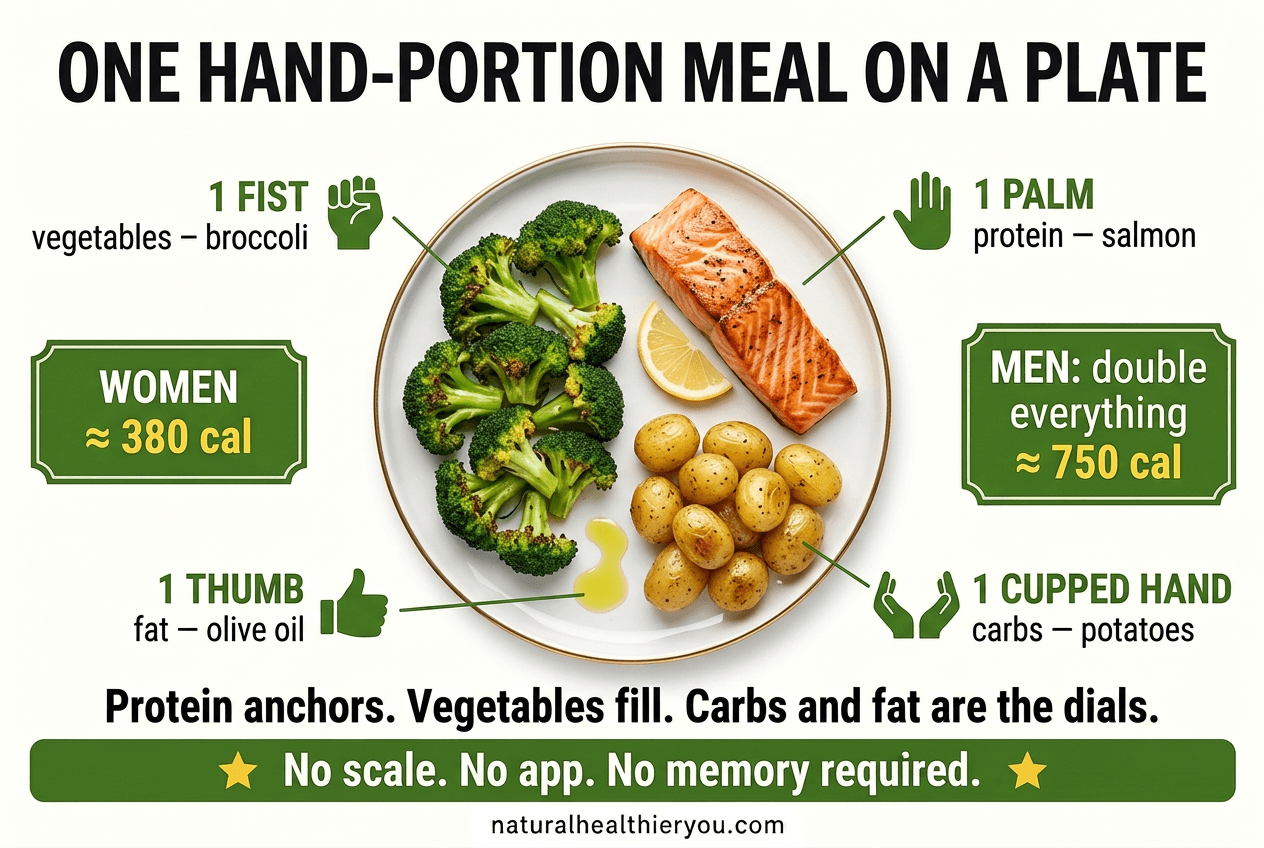
Salmon dinner (women's template)
Salmon fillet the size of your palm → protein, 1 palm
Roasted broccoli, a fist's worth (looks like a lot — that's the point) → vegetables, 1 fist
Roasted potatoes, a cupped handful → carbs, 1 cupped hand
The olive oil you roasted everything in, about a thumb → fat, 1 thumb
Total: roughly 380 calories, 30+ grams of protein, filling, and you never measured anything.
Same dinner, men's template: two palms of salmon (a normal restaurant fillet), two fists of broccoli, two cupped hands of potatoes, two thumbs of oil. About 750 calories.
Breakfast (women's): 2 eggs (1 palm) · a fist of spinach cooked in · 1 slice whole-grain toast (1 cupped hand) · a thumb of butter or a thumb of avocado. ~370 calories.
Lunch (women's): a palm of grilled chicken · two fists of salad greens (vegetables are free — go big) · a cupped hand of chickpeas or quinoa · a thumb of olive oil in the dressing. ~380 calories.
Notice the pattern: protein anchors every meal, vegetables provide the volume, and carbs and fat are the adjustable dials.
Hand Portions for Food That Isn't a Neat Pile
The neat-plate examples are easy.
Real life is a burrito bowl, a bowl of pasta, a slice of pizza.
Here's how to handle the messy cases:
Mixed dishes (stir-fry, chili, curry, casserole):
Estimate the components.
A big bowl of chicken stir-fry over rice is usually a palm of chicken, a fist of vegetables, one to two cupped hands of rice, and one to two thumbs of oil.
You'll be close enough — the goal is direction, not precision.
Pasta:
One cupped hand of cooked pasta is about ⅔ cup — far less than most people serve.
A typical restaurant bowl is 3–4 cupped hands.
Order it, eat one or two cupped hands with a palm of protein and a fist of vegetables, box the rest.
Pizza:
One slice of a standard large pizza ≈ 1 cupped hand of carbs + 1 thumb of fat + about half a palm of protein.
Two slices with a fist of salad is a reasonable meal.
Four slices is two meals.
Sandwiches:
Two slices of bread = 2 cupped hands.
That's your carbs for the meal.
Add a palm of turkey or tuna, load it with a fist of vegetables, and a thumb of mayo, hummus or avocado — not three.
Snacks:
Use the same hand.
A snack is one or two portions, not a meal: a cupped hand of fruit + a thumb of nut butter.
A palm of Greek yogurt.
A fist of carrots + a thumb of hummus.
The thing to avoid is a snack that's three thumbs of fat and two cupped hands of carbs — which is what a granola bar and a handful of trail mix add up to.
Restaurants:
The typical entrée is 2–3× the women's template.
Use your hand to decide before you start: eat one palm, one fist, one cupped hand, box the rest.
Same trick as the food-swaps and hunger posts — decide in a calm moment, not a hungry one.
Drinks:
Liquid calories don't fit the hand system, which is one more reason to keep them out.
A 12-oz juice is about two cupped hands of carbs with none of the fullness.
How to Adjust for Weight Loss
Start with the template for two weeks.
Don't change anything else.
Then check: is your weight trending down, are clothes looser, is energy stable?
If yes — keep going. Don't cut further.
Slower is more sustainable and protects muscle.
If no — remove one portion per day.
Specifically: drop one cupped hand of carbs or one thumb of fat from one meal.
That's about 100–120 calories.
Give it two more weeks.
If still nothing, remove one more.
Two removed portions is roughly a 250-calorie deficit, which for most people is a half-pound to a pound a week [7].
Never remove protein or vegetables.
Protein is what keeps you full and keeps your muscle; vegetables are nearly free.
The adjustable dials are always carbs and fat.
This is the other big advantage over calorie counting: adjusting is trivial.
You don't recalculate a target.
You take one cupped hand off the plate.
Why It Works When Counting Doesn't
Four reasons, each backed by something real:
1. It doesn't rely on memory.
The Columbia study showed the failure point in calorie counting is recall — people forget 20% of what they eat within a day [1].
The hand method is used at the moment of serving, so there's nothing to remember.
2. It corrects portion distortion at the source.
The bowl-size research shows your eyes use the container as the reference [4,5,6].
The hand method replaces the container with a reference that never changes size.
A palm of chicken is a palm of chicken whether it's on a 9-inch plate or a 13-inch one.
3. It's built around protein and fiber first.
Every meal starts with a palm of protein and a fist of vegetables — which, as we covered in why you're always hungry, are exactly the two things that trigger your fullness hormones.
The template isn't just controlling calories; it's building meals that make you want to stop.
4. People actually keep doing it.
Precision Nutrition's data across tens of thousands of clients found hand portions came within roughly 10% of weighed-and-measured accuracy — with a fraction of the effort [7].
A method that's 90% as accurate and that you'll still be using in a year beats one that's 100% accurate and abandoned by February.
Where a Done-for-You Plan Fits
The hand method tells you how much.
It doesn't tell you what to cook, and for a lot of people that's the real Tuesday-night problem — standing in the kitchen, tired, with the right portion sizes in your head and no idea what to make with them.
If that's you, a structured plan removes the decision.
The one we point readers to is The Simple Slim Kitchen — a 30-day system of 62 simple recipes with the shopping lists and prep order already worked out.
The meals are built the way the hand template is: protein anchor, vegetables for volume, modest carbs and fat. You cook from the plan and the portions take care of themselves.
Good for you if: you know what a good plate looks like now and just want the "what's for dinner" question answered for a month.
Not for you if: you already have five or six go-to meals you like. Rotate those with the hand template and you're done — don't buy what you don't need.
It's $17, digital, with a 60-day money-back guarantee.
Take a look at The Simple Slim Kitchen →
Affiliate link — we may earn a commission at no extra cost to you.
Common Mistakes
Counting fingers as palm.
The palm is the flat part — no fingers, no thumb.
A "palm" that includes fingers is almost double the protein (not a disaster, but it throws the template off).
Heaping the cupped hand.
A cupped hand is a loose handful, level with your fingers.
Not a mound.
This is where rice, pasta and cereal portions quietly double.
Ignoring the cooking fat.
The oil in the pan, the butter on the vegetables, the dressing on the salad — all thumbs.
Most people count the visible fat (the cheese, the avocado) and forget the invisible fat.
It's often two or three thumbs a meal they never see.
Treating fruit as free.
Fruit is a carb — a cupped hand. It's a good carb, with fiber, and it should be in your day.
But three apples and a banana are four cupped hands, not "just fruit."
Using someone else's hand.
If you cook for a family, portion by each person's hand, not yours.
Your teenage son's palm is not your palm.
This is also the method's quiet genius: it gives every person at the table their own correct portion without a single measurement.
Frequently Asked Questions
How accurate is the hand portion method?
Within roughly 10% of weighing and measuring, according to Precision Nutrition's data on tens of thousands of clients. That's accurate enough for weight loss, and far more accurate in practice than calorie counting from memory, which is typically off by 20–50%.
How many hand portions should I eat a day to lose weight?
Start with the template — women: 1 palm, 1 fist, 1 cupped hand, 1 thumb per meal; men: 2 of each — for two weeks. If weight isn't trending down, remove one cupped hand of carbs or one thumb of fat per day and reassess after two more weeks.
Does the hand portion method work for people with small or large hands?
Yes — that's the point. Hand size roughly tracks body size, so bigger people (who need more food) automatically get bigger portions. It self-scales in a way that fixed measurements like "½ cup" can't.
Is the hand portion method the same as the plate method?
They're compatible. The plate method (half vegetables, quarter protein, quarter carbs) describes the layout; hand portions describe the amounts. Using both together — a fist or two of vegetables filling half the plate, a palm of protein, a cupped hand of carbs — is the easiest version.
Can I use hand portions if I don't want to lose weight?
Yes. The base template is a maintenance starting point for many people. To gain muscle or fuel heavy training, add cupped hands of carbs and palms of protein; to lose, remove carbs and fat. The method adjusts in both directions.
Key Takeaway
You don't need to count calories to control portions — you need a reference that's always with you and never lies.
Palm of protein, fist of vegetables, cupped hand of carbs, thumb of fat, at every meal.
Start with the template, hold it for two weeks, then adjust by one portion at a time.
It's 90% as accurate as a food scale and you'll still be doing it next year.
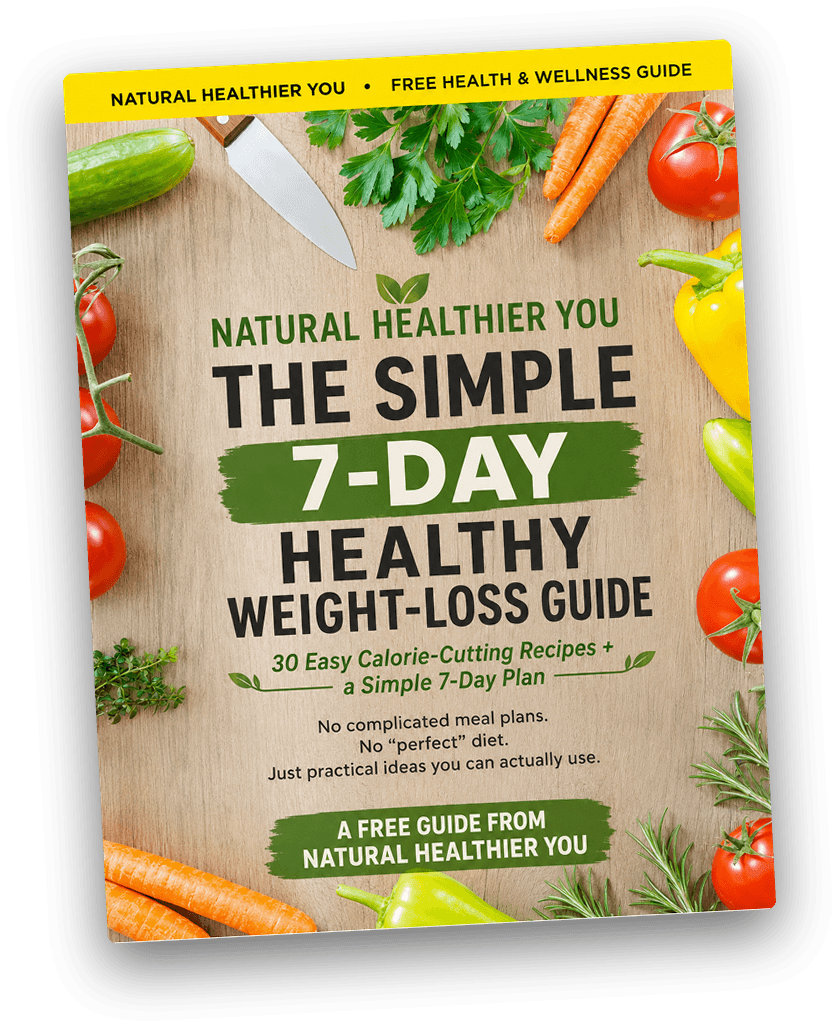
FREE DOWNLOAD
Want it laid out for you?
Our free 7-Day Weight-Loss Guide uses these exact portions — a palm of protein, half-plate vegetables — in a day-by-day plan with a shopping list and 30 simple recipes. No counting anywhere in it.
No spam. Unsubscribe anytime.
Sources
Lichtman SW et al. Discrepancy between self-reported and actual caloric intake and exercise in obese subjects. New England Journal of Medicine, 1992;327:1893–1898.
Goris AHC & Westerterp KR. Underreporting of habitual food intake is explained by undereating in highly motivated lean women. Journal of Nutrition, 1999 — review of 20–50% underreporting across doubly-labeled-water studies. https://www.sciencedirect.com/science/article/pii/S0022316623020266
Young LR & Nestle M. The contribution of expanding portion sizes to the US obesity epidemic. American Journal of Public Health, 2002;92(2):246–249.
van Kleef E, Shimizu M, Wansink B. Serving bowl selection biases the amount of food served. Journal of Nutrition Education and Behavior, 2012. https://www.sciencedirect.com/science/article/abs/pii/S1499404611000959
Wansink B, van Ittersum K, Painter JE. Ice cream illusions: bowls, spoons, and self-served portion sizes. American Journal of Preventive Medicine, 2006;31(3):240–243.
Wansink B, Painter JE, North J. Bottomless bowls: why visual cues of portion size may influence intake. Obesity Research, 2005;13(1):93–100. https://onlinelibrary.wiley.com/doi/full/10.1038/oby.2005.12
Precision Nutrition. Hand-Size Portion Guide and How to do hand portion math to track your macros. https://www.precisionnutrition.com/hand-portion-math-to-track-macros
This article is for educational purposes only and is not medical advice. Consult your healthcare provider before making significant changes to your diet, especially if you have a medical condition or take medication. Natural Healthier You participates in affiliate programs; see our affiliate disclosure.
About this article
Written by Matthew and the Natural Healthier You team
We write about the small, boring habits that actually stick: protein first, half-plate vegetables, fewer calories you drink. Every claim links to a peer-reviewed study or a public health source in the Sources list. We test recipes in our own kitchens, and when we recommend a product we say who it is not for. Nothing here is medical advice.
How we research and choose what to recommend →Free 7-day guide →
NATURAL HEALTHIER YOU
Simple, practical health and weight-loss guidance for real life.
Natural Healthier You. All rights reserved. Content is for general informational purposes only and is not medical advice. Consult your healthcare provider before starting any diet or supplement. Some links on this site are affiliate links; we may earn a commission at no extra cost to you.