Free: 30 calorie-cutting recipes + a 7-day plan → Get the guide





Why You're Always Hungry: 7 Science-Backed Ways to Feel Full Naturally

By Matthew & the Natural Healthier You team
Picture two people at the same dinner table, eating the same meal.
One of them gets halfway through, sets the fork down, and genuinely doesn't want the rest.
Not "shouldn't have" — doesn't want. The other finishes the plate, eyes the bread basket, and is mentally in the pantry before dessert arrives.
If you've always been the second person, you've probably been told the difference is discipline. Willpower. Self-control.
It isn't. It's chemistry.
Your body runs an appetite-control system built on hormones — chemical messengers that tell your brain when to eat and when to stop.
In some people that "stop" signal is loud and quick.
In others it's weak, late, or drowned out by modern food and modern life.
And if yours is weak, no amount of white-knuckling was ever going to fix it, because you were fighting a signal, not a habit.
The good news is that this system responds to how you eat, sleep, and move.
In this post we'll explain what's actually happening in your body when you're hungry an hour after a full meal, and then give you seven research-backed ways to turn the fullness signal back up.
No prescription, no starvation, nothing weird.
Let's start with the hormones, because once you understand them, everything else makes sense.
Meet the Hormones That Decide When You're Full
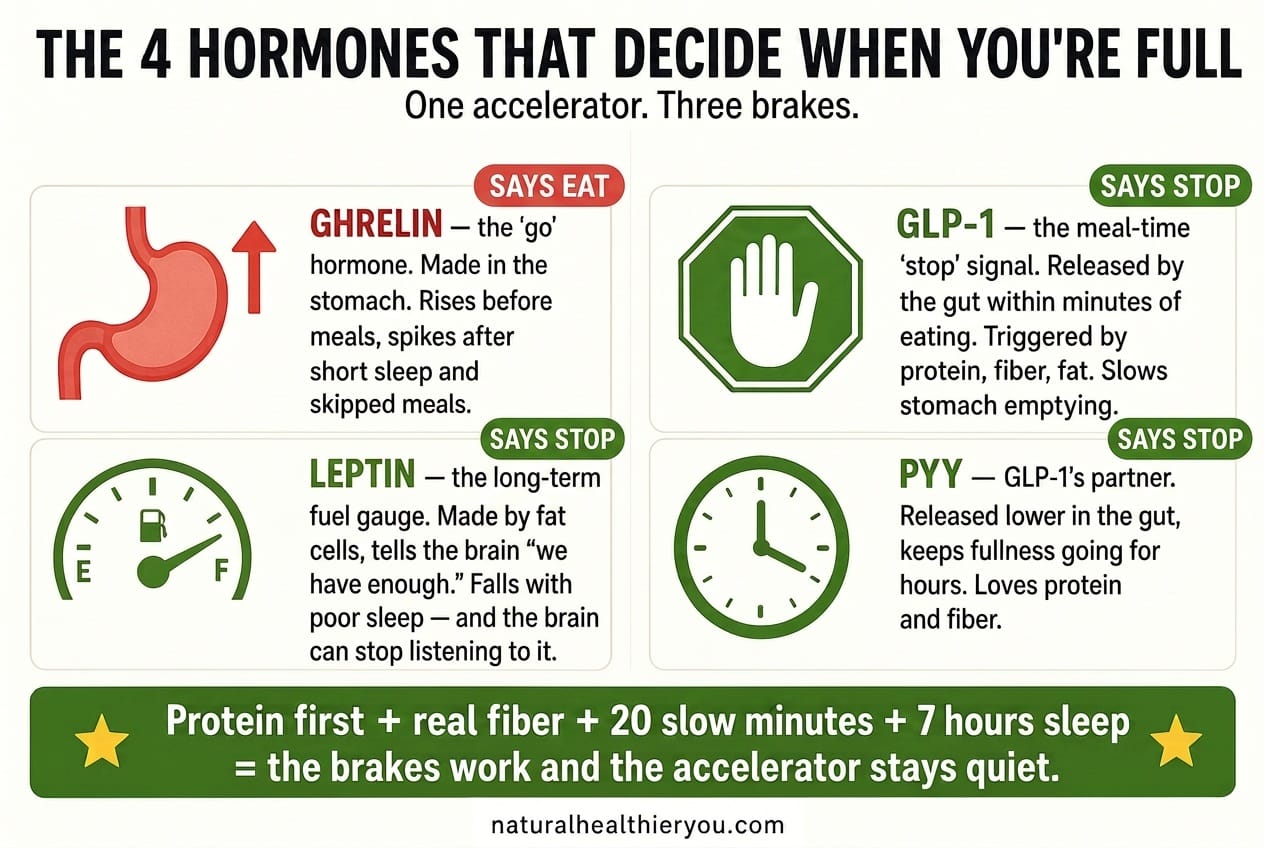
There are four you need to know. One says "eat," three say "stop." Think of it as one accelerator and three brakes.
Ghrelin — the "go" hormone. Made in your stomach, it rises before meals and falls after. When you say "I'm starving," that's ghrelin talking. It also spikes when you sleep badly and when you go too long between meals.
Leptin — the long-term "we have enough" hormone. Released by fat cells, it tells your brain how much fuel is stored. The catch: in chronic overeating and poor sleep, the brain stops listening to it — a condition called leptin resistance. You have plenty of fuel and still feel hungry.
GLP-1 (glucagon-like peptide-1) — the meal-time "stop" hormone. Released by cells in your gut within minutes of eating, especially in response to protein, fiber, and fat. It tells your brain you're satisfied, slows how quickly your stomach empties, and steadies blood sugar. If that name sounds familiar, it's because the popular injectable weight-loss drugs are built to mimic it. Your body makes it for free — the question is how much.
PYY (peptide YY) — GLP-1's partner. Released further down the gut, it kicks in a little later and keeps the "stop" signal going for hours after a meal. Protein and fiber are its favorite triggers.
Here's the key insight: hunger isn't one dial. It's a conversation between these four. When your meals are built to raise GLP-1 and PYY, and your sleep and routine keep ghrelin calm, the conversation ends with "we're good." When you eat fast, low-protein, ultra-processed food on five hours of sleep, ghrelin shouts and nobody answers.
Everything below is about changing that conversation.
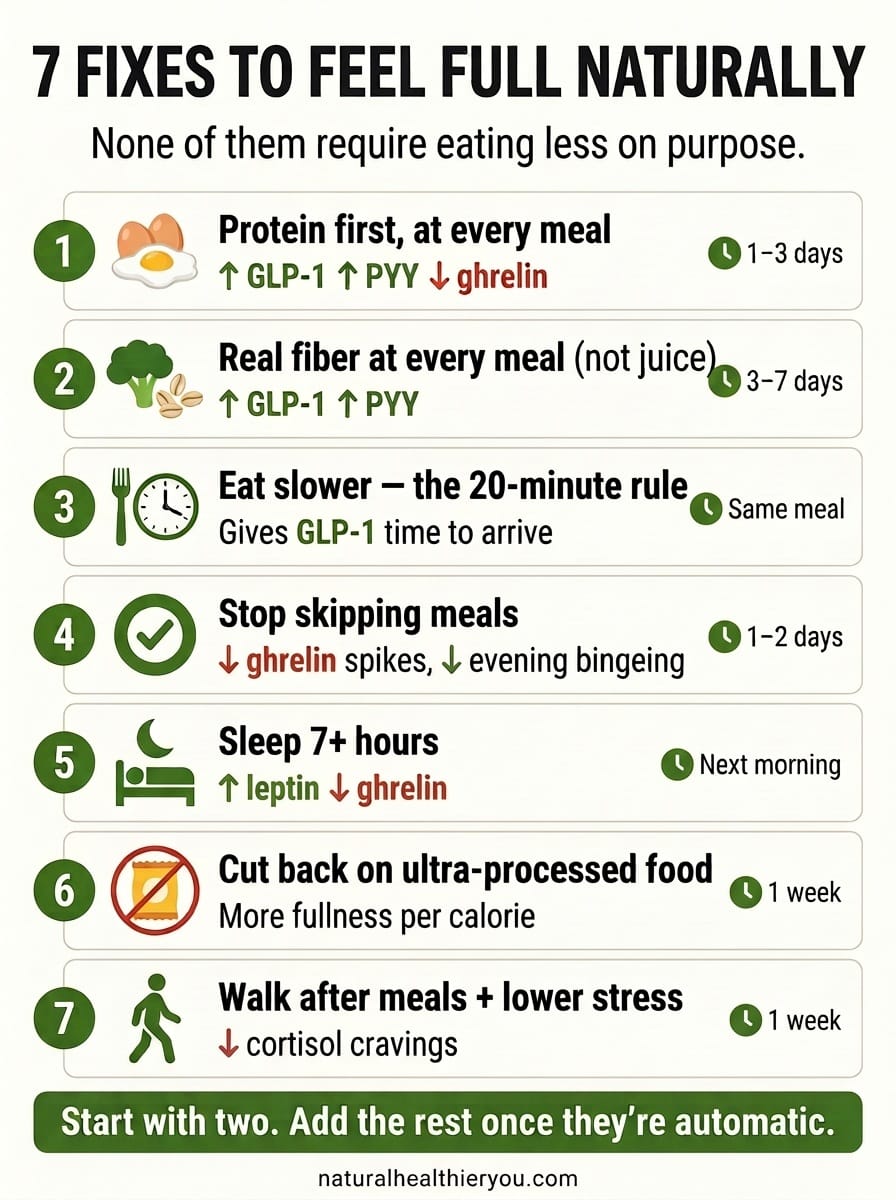
The 7 Fixes at a Glance
| # | Fix | Main hormone it affects | How fast you'll notice |
|---|---|---|---|
| 1 | Protein first, at every meal | ↑ GLP-1, ↑ PYY, ↓ ghrelin | 1–3 days |
| 2 | Fiber at every meal (real fiber, not juice) | ↑ GLP-1, ↑ PYY | 3–7 days |
| 3 | Eat slower — the 20-minute rule | Gives GLP-1 time to arrive | Same meal |
| 4 | Stop skipping meals | ↓ ghrelin spikes, ↓ evening bingeing | 1–2 days |
| 5 | Sleep 7+ hours | ↑ leptin, ↓ ghrelin | Next morning |
| 6 | Cut back on ultra-processed food | Restores fullness per calorie | 1 week |
| 7 | Walk after meals + manage stress | ↓ cortisol-driven cravings | 1 week |
None of these requires eating less on purpose. Eat the right things in the right order and "less" happens by itself.
Six Things That Quietly Weaken Your Fullness Signal
Before the fixes, it helps to know what you're fixing. If you recognize yourself in three or more of these, you've found your answer to "why am I always hungry":
Carb-heavy breakfast (or no breakfast). Cereal, toast, a bagel, a granola bar — or nothing at all. Neither triggers much GLP-1, and both set up a mid-morning crash.
Eating fast. The average American meal takes under 15 minutes. The fullness signal takes about 20 to arrive. You finish before it does.
Drinking calories. Juice, soda, sweet coffee. Liquid calories barely register with the hormones that say stop. (We covered this in 10 easy food swaps.)
Short sleep. One bad night measurably raises ghrelin and lowers leptin the next day. Chronic short sleep does it every day.
Ultra-processed food. Engineered to be eaten fast and to deliver a lot of calories before fullness catches up.
Age and stress. GLP-1 response naturally declines with age, and chronic stress raises cortisol, which drives cravings for sugar and salt specifically.
Now the fixes.
1. Eat Protein First — at Every Meal
What to do: Get 25–30 grams of protein at each meal, and eat it first — before the bread, the rice, the salad even.
Why it works: Protein is the strongest food trigger for both GLP-1 and PYY, and it suppresses ghrelin more than carbs or fat do. The order matters too: when protein hits the gut first, the "stop" signal starts building before you've had a chance to overeat the rest of the plate.
The breakfast research here is striking. In a series of studies at the University of Missouri, researcher Heather Leidy compared a high-protein breakfast (about 35 g) with a typical cereal breakfast and with skipping. The high-protein breakfast raised PYY, lowered ghrelin, reduced activity in the brain regions that drive food cravings, and — this is the part people feel — cut evening snacking on high-fat, high-sugar foods [1]. A 2025 study confirmed the hormone effect holds whether the protein comes from animal or plant sources [2].
How to make it easy: 30 g of protein looks like: 3 eggs + a slice of cheese · a cup of Greek yogurt + a scoop of protein powder · a chicken breast · a can of tuna · a cup of cottage cheese · a scoop of whey in milk. Keep two of these in rotation and breakfast is solved.
2. Put Real Fiber at Every Meal
What to do: Vegetables, beans, lentils, oats, whole fruit, nuts. Aim for a fist of vegetables or a half-cup of beans/oats at each meal — roughly 25–35 g of fiber a day.
Why it works: Fiber does two things. It physically slows digestion, so the meal releases energy over hours instead of minutes. And when the bacteria in your colon ferment it, they produce short-chain fatty acids that directly stimulate the gut cells that release GLP-1 [3]. That's why a bowl of oats keeps you full until lunch and a bowl of cornflakes doesn't, even at the same calories.
This is also why whole fruit fills you up and juice doesn't. The fiber is the fullness. Strip it out and you've got sugar water with vitamins.
How to make it easy: Add, don't subtract. Keep a bag of frozen vegetables and a can of beans on hand and put a handful into whatever you were already making — eggs, pasta, soup, rice. Fiber intake goes up without a single new recipe.
3. Eat Slower — the 20-Minute Rule
What to do: Make every meal last at least 20 minutes. Put the fork down between bites. Drink water. Talk.
Why it works: GLP-1 and PYY take roughly 20 minutes to reach full strength after you start eating. A study in the Journal of Clinical Endocrinology & Metabolism found that the same meal eaten over 30 minutes produced a significantly larger GLP-1 and PYY response than when eaten in 5 [4]. Later research has been mixed on the hormone measurements, but the practical effect — a lower desire to eat an hour later — shows up consistently.
Think of it this way: eating fast isn't a character flaw, it's a timing problem. You finish the plate before your body has had a chance to tell you it's had enough.
How to make it easy: Start every meal with the slowest thing on the plate — a salad, a bowl of soup, the vegetables. Use a smaller fork. If you eat alone, no screens; distracted eating reliably speeds you up.
4. Stop Skipping Meals
What to do: Three real meals a day, roughly 4–5 hours apart. If you do intermittent fasting and it works for you, fine — but don't accidentally fast because the morning got away from you.
Why it works: Long gaps between meals let ghrelin climb, and high ghrelin does two things: it makes you hungrier, and it makes you reach for calorie-dense food specifically. That's why "I skipped lunch so I could have a big dinner" reliably ends with more total calories than three normal meals would have. The Missouri studies found that skipping breakfast produced the highest evening snacking of all conditions tested [1].
How to make it easy: The meal you're most likely to skip is the one to pre-decide. If it's breakfast, that's the Greek yogurt + protein powder cup — 90 seconds. If it's lunch, it's whatever you cooked extra of last night.
5. Sleep Seven Hours (Yes, This Is a Food Rule)
What to do: Seven to eight hours, most nights. Same wake-up time, even on weekends.
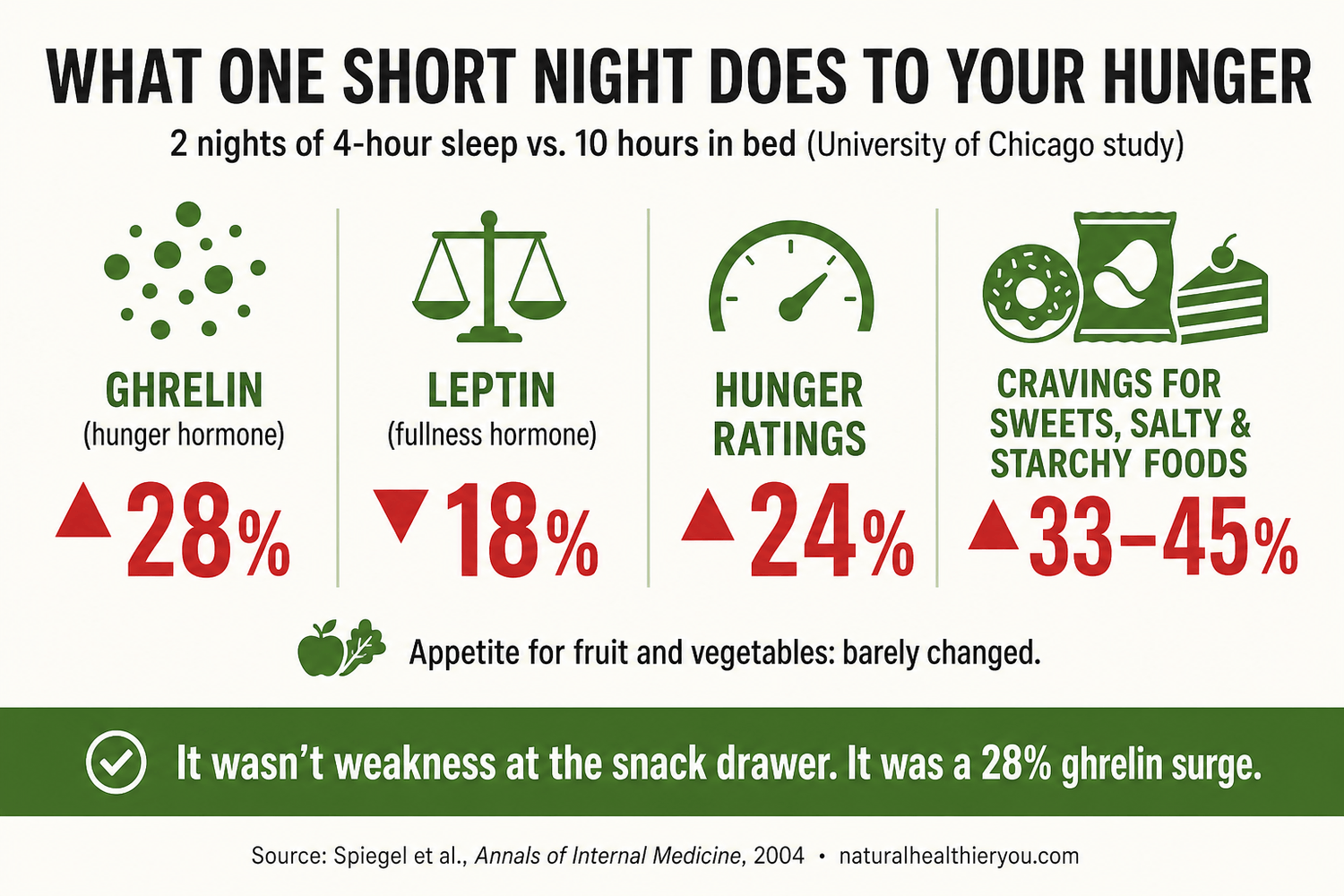
Why it works: This is the fix people skip because it doesn't feel like nutrition — and it might be the most powerful one on the list. In a landmark University of Chicago study, restricting healthy young men to four hours of sleep for two nights lowered leptin by 18%, raised ghrelin by 28%, and increased hunger ratings by 24%. Appetite for sweets, salty snacks, and starchy foods went up 33–45%. Appetite for fruit and vegetables barely moved [5]. Population studies show the same dose-response pattern: less sleep, more ghrelin, higher body weight [6].
If you've ever noticed you're unstoppable around the snack drawer the day after a bad night, that wasn't weakness. That was a 28% ghrelin surge.
How to make it easy: You don't have to fix your whole sleep life. Pick one lever: a consistent wake-up time, screens out of the bedroom, or caffeine cut-off at 2 p.m. Any one of them moves the needle.
6. Cut Back on Ultra-Processed Food
What to do: Shift the balance of what you eat toward food that looks like it did when it was alive. You don't need to be perfect — just move the ratio.
Why it works: In 2019, NIH researcher Kevin Hall ran the most tightly controlled diet study ever done on this question. Twenty adults lived on a metabolic ward for a month and ate an ultra-processed diet for two weeks and a minimally processed one for two weeks, matched for calories offered, sugar, fat, fiber, and salt. Told to eat as much or as little as they wanted, they ate about 500 more calories a day on the ultra-processed diet — and gained two pounds — without rating it any tastier [7]. They also ate it faster: about 17 more calories per minute. The food simply got past their fullness signal before it could fire.
Ultra-processed food isn't just "unhealthy." It's engineered to be eaten quickly, in quantity, before your body notices.
How to make it easy: Don't ban anything. Just apply the "one-ingredient" test to the anchor of each meal: the protein and the produce should be things with no ingredient list. What you put around them matters less.
7. Walk After Meals and Get Stress Out of the Kitchen
What to do: A 10–15 minute walk after your biggest meal. And one daily practice — any practice — that lowers your stress baseline.
Why it works: A short post-meal walk blunts the blood-sugar spike that follows a meal, which means a smaller crash an hour later — and the crash is what sends you looking for a snack. Stress works through a different channel: chronic cortisol raises cravings specifically for sugar and fat and makes the brain's reward system more responsive to junk food. You can't out-eat a stressed nervous system.
How to make it easy: Attach the walk to something you already do — take the call outside, walk the dog after dinner instead of before. For stress, the bar is low: ten slow breaths before a meal is enough to move you out of fight-or-flight and into rest-and-digest, where the fullness hormones actually work.
What a "Full All Day" Day Looks Like
Here's how the seven fixes stack in practice. Nothing exotic:
7:00 — Breakfast: 3 scrambled eggs with spinach and a slice of whole-grain toast. Coffee with a splash of milk. (Protein first, fiber, no liquid calories — Fixes 1, 2, 6.)
12:30 — Lunch: Big salad with a can of tuna or grilled chicken, half a cup of chickpeas, olive oil and balsamic. Eaten away from the desk, 20 minutes. (Fixes 1, 2, 3, 4.)
3:30 — Snack if needed: Greek yogurt or an apple with a tablespoon of peanut butter. (Protein + fiber, not a granola bar.)
6:30 — Dinner: Salmon or a lean burger patty, roasted vegetables, a small portion of rice or potatoes. Protein and vegetables first; starch last. (Fixes 1, 2, 3.)
7:00 — 15-minute walk. (Fix 7.)
10:30 — Lights out. Same time as last night. (Fix 5.)
Most people who run this day for a week report the same thing: the second helping just matters less. The bread basket loses its pull. Not because they're resisting it — because the signal that said "more" got quieter.
Where Supplements Fit (Honestly)
Let's be clear about the order of operations: the seven fixes above do most of the work, and no capsule replaces them. If you're eating a cereal breakfast on five hours of sleep, a supplement is a rounding error. Do the fundamentals first.
That said, some people do the fundamentals well and still feel their fullness signal is weaker than it should be — especially over 40, when the GLP-1 response naturally declines, or when cravings for sweets specifically won't quit. For that situation, there are plant compounds with real research behind them, and a handful of well-formulated products put them together.
The one we point readers to is GLP-1 Plus from Advanced Bionutritionals. It combines four ingredients that each target part of the fullness conversation:
Dihydroberberine (GlucoVantage®) — a more absorbable form of berberine, a plant compound long studied for blood-sugar and metabolic support. Ordinary berberine is poorly absorbed and hard on the stomach; this form addresses both.
Gymnema sylvestre — an herb used in Indian traditional medicine for centuries and nicknamed the "sugar destroyer." It temporarily dulls the perception of sweetness, which takes the edge off sugar cravings.
Cassia cinnamon extract — slows carbohydrate breakdown so glucose enters the blood more gradually, for steadier energy.
Chromium picolinate — a mineral your body needs for insulin to work properly.
Two capsules a day, with your biggest meal. It's $79.95 a bottle (less per bottle for three or six), and it's backed by a 90-day money-back guarantee that covers empty bottles — one of the better guarantees we've seen in this category.
Good for you if: you're doing the food and sleep side and cravings or portion control still feel like a fight.
Not for you if: you haven't tried the seven fixes yet — or you take blood-sugar medication. Berberine can compound its effect, so talk to your doctor first.
What Not to Do
Don't cut calories hard. A big deficit raises ghrelin and lowers leptin — the exact opposite of what you want. Aim for a modest 300–500 calorie gap, built from better food, not less food.
Don't replace meals with "diet" snacks. Rice cakes, 100-calorie packs, and low-fat everything have almost no protein or fiber. They're hunger with a health halo.
Don't drink your protein at dinner and eat cereal for breakfast. The order across the day matters. Front-load protein.
Don't try all seven at once. Pick the two that match your biggest weak spot — for most people that's breakfast protein and sleep. Add the rest once those are automatic.
Frequently Asked Questions
Why am I hungry an hour after eating a full meal?
Usually because the meal was low in protein and fiber and eaten quickly — so it triggered very little GLP-1 and PYY, and your blood sugar spiked and crashed. A meal built on 25–30 g of protein and a fist of vegetables, eaten over 20 minutes, keeps most people full for 3–5 hours.
What foods increase GLP-1 naturally?
Protein (eggs, fish, chicken, Greek yogurt, beans), fiber-rich foods (oats, vegetables, legumes, whole fruit), and healthy fats (nuts, olive oil, avocado) all stimulate GLP-1 release. Fermented foods and slow-digesting carbs help too. Ultra-processed food and sugary drinks do the least.
Does lack of sleep really make you hungrier?
Yes, measurably. In controlled studies, two nights of four-hour sleep raised the hunger hormone ghrelin by 28%, lowered the fullness hormone leptin by 18%, and increased appetite for sweet and salty foods by up to 45%.
Is constant hunger a sign of something medical?
It can be. Persistent hunger with thirst, frequent urination, or unexplained weight loss can indicate blood-sugar problems or thyroid issues, and some medications increase appetite. If hunger is new, extreme, or comes with other symptoms, see your doctor.
Do GLP-1 supplements work like the injectable drugs?
No. Prescription GLP-1 drugs are synthetic versions of the hormone at doses far above what your body produces. Supplements like berberine, gymnema, and cinnamon support your body's own response — a gentler effect that works best on top of good food and sleep habits, not instead of them.
Key Takeaway
Constant hunger is a signal problem, not a willpower problem. Your body already has a fullness system — you just have to feed it what it responds to: protein first, real fiber, slower meals, no skipped meals, enough sleep, less ultra-processed food, and a walk after dinner. Start with two of those and the rest of your eating gets easier without trying.
FREE DOWNLOAD
Want the done-for-you version?
Our free 7-Day Weight-Loss Guide turns these principles into a day-by-day plan — protein-first meals, the 20-minute rule, a full shopping list, and 30 simple recipes — so you don't have to think about any of it.
No spam. Unsubscribe anytime.
Sources
Leidy HJ et al. Beneficial effects of a higher-protein breakfast on the appetitive, hormonal, and neural signals controlling energy intake regulation in overweight/obese, "breakfast-skipping," late-adolescent girls. American Journal of Clinical Nutrition, 2013. https://ajcn.nutrition.org/article/S0002-9165(23)05462-X/fulltext
High-protein breakfasts (plant and animal) increase GLP-1 and PYY and reduce appetite vs. a high-carbohydrate meal. 2025. https://www.news-medical.net/news/20251113/High-protein-breakfasts-help-you-feel-fuller-but-do-not-change-how-much-you-eat-later.aspx
Dietary fibers to boost endogenous GLP-1 secretion and satiety: a scoping review. 2026. https://pmc.ncbi.nlm.nih.gov/articles/PMC13414124/
Kokkinos A et al. Eating slowly increases the postprandial response of the anorexigenic gut hormones, peptide YY and glucagon-like peptide-1. J Clin Endocrinol Metab, 2010;95(1):333–337.
Spiegel K, Tasali E, Penev P, Van Cauter E. Sleep curtailment in healthy young men is associated with decreased leptin levels, elevated ghrelin levels, and increased hunger and appetite. Annals of Internal Medicine, 2004;141(11):846–850.
Taheri S et al. Short sleep duration is associated with reduced leptin, elevated ghrelin, and increased body mass index. PLoS Medicine, 2004.
Hall KD et al. Ultra-Processed Diets Cause Excess Calorie Intake and Weight Gain: An Inpatient Randomized Controlled Trial of Ad Libitum Food Intake. Cell Metabolism, 2019.
This article is for educational purposes only and is not medical advice. Consult your healthcare provider before making changes to your diet, sleep, or supplement routine, especially if you have a medical condition or take medication. Natural Healthier You participates in affiliate programs; see our affiliate disclosure.
NATURAL HEALTHIER YOU
Simple, practical health and weight-loss guidance for real life.
Natural Healthier You. All rights reserved. Content is for general informational purposes only and is not medical advice. Consult your healthcare provider before starting any diet or supplement. Some links on this site are affiliate links; we may earn a commission at no extra cost to you.